Saturday, 23 June 2012

The Refugee Experience

I’m just back from Maban County, Upper Nile state.  Things in Blue Nile state of Sudan are even worse than they are in Greece, with rather more bombing of civilians, so people are crossing the border.

Our compound is just outside Doro camp, which has 35,000 refugees.  20,000 are children and all of them managed to get themselves in a photo I took at the airstrip this morning.  Just up the road is Yusuf Batil camp, which has about 15,000 refugees and space for 20,000 more before the hot tubs get too crowded.  Every day 3,000 fresh refugees get brought down from the border by the UN in trucks that look disturbingly like they transported cattle in a previous life.

The Refugee Bus
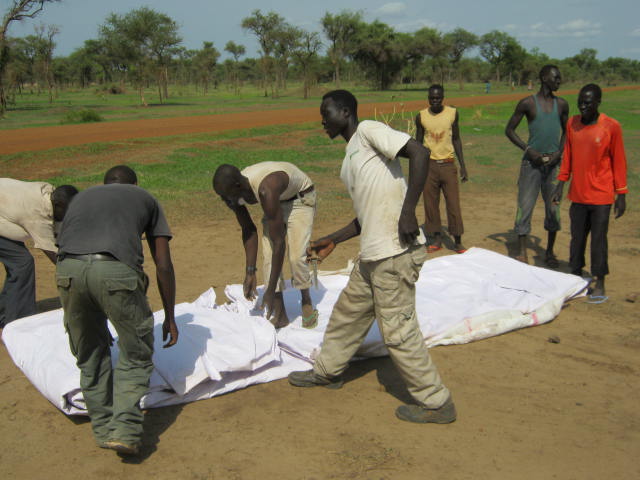
7,000 of the new arrivals at Yusuf Batil are without shelter, but don’t worry – I spent most of yesterday building a tent warehouse (Rubhall) where we will store 1,000 tents for these folk.  We flew over the camp this morning and I was amazed to see the Rubhall still standing.


Yusuf Batil camp from the air - our Rubhall is the white building furthest right

In fact the most overcrowded, barbaric living conditions for anyone in Maban is in the compound we share with the Danish Refugee Council, who are doing marvellous work in refugee health and in lending us their vehicles.  Every inch of the compound is covered by a tent, each housing at least two people.  I slept on a mattress on the floor of the office, and was awoken every four minutes by assorted flying rodents alighting on my face.

My quarters
We are hiring vehicles and drivers from a Kenyan company, and last week they sent our next driver up from Nairobi.  This poor fellow was put on a plane in this vague direction, and found himself with 20,000 refugees in Jammam camp, a long way from Doro.  He spent three days there for some reason, and eventually managed to cadge a ride to our place on the back of a motorbike, which took four hours.  It appeared that his only worldly possessions were a box of spare parts and a shovel; needless to say he wasn’t impressed by his commute to work.

Yesterday was World Refugee Day, which seems a strange sort of thing to celebrate.  They had dancing and football and goat-murder and the usual festive things.  The parties continued well into the night, although I may have confused the end of the celebrations with a wedding.  At any rate the cacophony outside our compound was ludicrous – singing, howling, ululating, drums.  The pack of wild dogs needed no excuse to join in, along with a single psychotic donkey.  Someone even seemed to be playing the didgeridoo; heaven only knows what possessed him to grab this as he fled his house with only the bare essentials, but I wish he hadn’t.


Saturday, 9 June 2012

Thailand and Kenya

In my last blog before going on holiday to Thailand I promised you jokes about Thai prostitutes, but I can’t make any jokes because I didn’t see any prostitutes.  On the plus side I found myself to be very popular with the ladies in Bangkok, especially the ones with Adam’s apples.

We spent a few days in Bangkok swimming in people’s rooftop pools and generally being fabulous.  We devoted a day to the visual arts, and I can report that the new ‘Avengers Assemble’ film is excellent.   Also interesting is a visit to the Khao San Road to look at the backpackers, although you have to make sure you wash your hands if you touch any.

The Grand Palace is amazing, with its Temple of the Emerald Buddha, where a little green Buddha the size of a hamster sits on an enormous pile of golden and bejewelled paraphernalia.  There is also a sign saying ‘Beware of your Valuables’, which is good advice if you are worried your camera is going to bite you.  The lavatories are divided into Men, Women and Monk.


We went to the paradise beach locations of Koh Phi Phi and Railay, where we adopted the traditional Thai beach diet of prawn curry and Sangsom buckets.  When you arrive in Phi Phi you are herded by cattle prod into a boat to visit Maya Bay, which is every bit as underwhelming as the location for disappointing Hollywood blockbuster The Beach sounds, although they have cool urinals cut into the cliffs.  Phi Phi used to be a trashy resort with nothing but cheap hostels and sleazy bars, but the 2004 tsunami devastated it, enabling it to be rebuilt as a trashy resort with nothing but cheap hostels and sleazy bars.

I had a weekend in Kenya before returning to Juba, and a trip to Hell’s Gate national park was just the thing.  You can hire bikes and ride past antelopes, zebras and giraffes; if they all run in the same direction then it’s best to follow them.  Quite a good joke is to ride past another tourist at top speed, screaming “LION!!!!!!!!”, to see if they take the bait.

Another good thing to do in Nairobi on a Sunday is to visit the Karen Blixen house.  The traffic was light so we covered the 5 mile journey in under a day, and it turns out that an NGO ID from South Sudan is enough to prove one’s Kenyan residence and qualify for reduced admission.  In the gift shop they have a series of books about living with clinical depression and terminal disease, for some reason.

Sunday, 6 May 2012

The trouble with war

One of the troublesome side effects of war is that you very quickly run out of stuff.  South Sudan is running out of lots of things, most notably money.  The exchange rate is going north by the day - your $100 bill would get you 350 South Sudanese Pounds a month ago and now you're looking at close to 500.

Juba is also experiencing a severe shortage of fuel, which logistically speaking is the bread and butter of almost all organisations, and a severe shortage of actual bread and butter.  I passed a bakery this evening and it was like the floor of the New York Stock Exchange in 1985.  A lack of butter is turning people to Blue Band Margarine, a disgusting Ugandan margarine substitute made of petroleum jelly and ear wax.

I was in the town of Bentiu, close to the border, a couple of weeks ago, but we had to leave because the North kept bombing the town.  They chose some strange targets, including the market and various fields, but since they drop the bombs by having soldiers push them out the back of Antonov cargo aircraft I guess they aren't very accurate.

No one seems to know what is going on at the border now.  It's hard to imagine either side winning a war,  considering the state of the two economies.  Sudan at least has a few planes, but they are so old and Russian that they can't fly from Khartoum to Juba without a stop for fuel and repairs along the way.  South Sudan doesn't have two planes to rub together, although I heard a rumour that they have one.

Another unfortunate consequence of war is that the UN have filled our football field with tanks, in an awesome show of power that will have no effect since everyone knows that UN peacekeepers are far too busy playing volleyball and being bad at DJing to leave their compound.

I'm off to Thailand tomorrow on R&R for two weeks, so prepare yourself for tedious jokes about prostitutes when I return.

Monday, 9 April 2012

Bentiu - for real

There are 20,000 Nuban refugees hanging around at a camp in Yida just south of the border, and the UN is trying to move them fifty miles south where they will be less in the middle of a battlefield.  The trouble with refugees is that you can’t just load them into the back of a pickup and move them – they have to move of their own accord.  The particular trouble with these refugees is that they are mountain folk who want to stay close to their mountains for fear of disorientation, so they are not at all keen to come south.  The UN is trying to lure them south with the promise of schools in Nyiel and a university in Pariang, and our job is to make those facilities irresistible.


A bit of Nyiel Refugee Camp, waiting for refugees

We are based in Bentiu and going by road through the oilfields to those sites when the road is safe and no one is dropping bombs on it.  It’s a 6 hour round trip to Pariang, which is almost as bad a commute as people who use British Rail in the winter experience, and a 3 hour one to Nyiel, which feels round the corner in comparison.

I sat in on a P5 health and hygiene lesson in Nyiel, where we learnt about washing our hands and sang some songs.  Half the school is housed in temporary longhouses, divided into four classrooms by plastic sheets.  My class concentrated well and weren’t too distracted by my presence, but close to me was a hole in the sheet and children from the nursery class were taking it in turns to peer through it in wonder and disgust.  Every so often they were yanked away by some unseen and no doubt exasperated teacher, but more kids would take their place at the peephole.  Eventually an enormous bottom appeared and filled the hole, as the teacher sensibly used herself as a plug, and her class were once again able to concentrate.


Nyiel refugee camp urchins

The camp in Nyiel is nice, but there’s only about 1,000 people there.  Rows of empty tents sit waiting.  The UN have installed a very nifty solar powered pump that fills a raised bladder; when taps in the camp are opened, gravity causes the water to flow out and the pump refills the bladder provided that it’s sunny, which is a reasonable assumption.


Nifty pump in Nyiel
 The Easter weekend in Bentiu was not full of incident, although we did eat caviar brought from Moscow by a UN pilot and threw a rugby ball about in front of bemused locals.


Bentiu Grand Hotel - two out of three ain't bad


Thursday, 29 March 2012

Bentiu - nearly

I'm writing this from Bentiu, capital of Unity state, or I would be if someone didn't keep dropping bombs on it.  The UN and the NGOs are evacuating most of their staff today so my trip will have to wait till Tuesday next week, when we'll try again.

Observers of events in these parts over the last 50 years will know that these guys don't need an excuse to fight, but this time they have one.  The black South and the arab North are going at it again for control of the Heglig oil field, and its all-crucial Central Processing Facility.  All oil from South Sudan goes through the north as that's where the only pipeline goes, and two months ago the South took its ball home and turned off the pumps as it was convinced the north was siphoning it off along the way.  Holding the CPF would be a good way to do a similar siphoning trick as all the oil from north and south goes through it.

Seeing as 98% of South Sudan's revenue is from oil, its sulking raises two major questions.  How will it now feed its people, and where the hell did the other 2% come from?  The first question is moot as South Sudan has never bothered to feed its people, preferring to splash out on heavy artillery.  As for the second question, my visa must have contributed a hefty portion, as it's $100 just to set foot in the country.  I imagine that import duty on ministerial Hummers has been significant too.  Of course, technically they can't charge you for importing things because they haven't got around to writing any laws yet but that's another story.

Sunday, 18 March 2012

Weapons

There are rather a lot of weapons in South Sudan; this is what you get when you host a war for the best part of fifty years.  If anyone wants an AK47, I can get you one for the going rate of $13.  The government has been carrying out disarmaments recently.  This is an invitation for everyone to bury all but one of their guns in the bush, and hand over the one that's left, on the basis that no one could possibly have more than one.  This assumption has led to unfortunate incidents where people have been beaten up by soldiers for not handing over a gun, when they didn't have one in the first place.  Last week in the town of Bor the army even disarmed the police, who are supposed to be armed, and had to re-arm them after a hasty phone call.

There are lots of land mines and UXOs (unexploded ordnance) on the Jebel, the rather pretty hill on the outskirts of Juba that people climb when they can't think of anything better to do with their sunday.  This is not because mines were planted there during the war.  In fact, a couple of years ago the government gathered all the mines and UXO they could find around Juba and put it in a pile on the Jebel.  They then tossed on a lot of sticks of dynamite, hoping that a controlled explosion would be the result.  What actually happened was that several tons of explosives were blown into the air, and rained down all over the mountain.  A de-miner actually lost a leg, not because he trod on a mine but because a mine fell from the sky onto his leg.  It didn't even explode.  Anyway, hikers on the Jebel would be well advised to take a companion and follow in their footsteps a few paces behind, ready to turn back in case the companion suddenly travels a long way in a vertical direction.

Sunday, 15 January 2012

Health - a rebuttal

I've had complaints that this blog makes South Sudan sound like a bit of a lark and that it's all swimming in the river and playing with kittens.  A while ago a well-respected commentator wrote that 'there are so many twenty-something Americans working at places like Save the Children that Juba feels like a giant frat party.'  I will not confirm or deny this - I will however write a bit about disease in the hope of garnering some sympathy for my situation.

It is not easy staying healthy here.  The bugs and the bacteria bask in the hot, wet climate, and all of the sane doctors left years ago to work somewhere they would get paid, leaving the other kind of doctors.  If we get ill we head to one of the small private clinics which are expensive but preferable to the state-run Juba Teaching Hospital.  I passed an unpleasant hour there on an errand and saw the biggest rat I have ever seen in one of the wards (it may have been a squirrel).  I heard of a boy who was hit by a car, taken to JTH and given an official report of his condition that said 'he has a fever, and a headache in the buttocks'.

We are pretty used to our colleagues turning strange colours and missing days of work.  Malaria is endemic - at any one time at least one of my colleagues is usually struggling with it.  Generally you can zap it with drugs in a couple of days, but it's a good excuse to be miserable in the office.  Typhoid is another favourite; so many people come back with it from one of our field bases that they must hand it out at the door.

Another health hazard is the Nairobi Fly.  This is a small red and black thing that behaves like a fly in all respects, but if you swat it then it explodes in a shower of acid that leaves horrific blisters on your skin for days.  This is what would have happened if someone had swatted the Alien in that film, and I can confirm that the terror that greets a swarm of Nairobi flies is comparable to that experienced by the crew of that space ship.

About two years ago we had a visit from the internal audit department in London.  One of the auditors had a miserable week in middle-of-nowhere Waat, struck down by various ailments.  While waiting for the plane to take him back to health and civilisation he had to dash to the loo, and the plane landed and took off while he was there so he had to wait a week for the next one.  South Sudan has become a bogey land to people at HQ, something like a cross between Timbuktu and the Bermuda Triangle, and stories abound of giant fire-breathing snakes, flesh-eating diseases contracted from public transport and murderous bacteria that creep into kitchens and lie quietly among the breakfast things.  When I was last visiting the office in London I did nothing to dispel these rumours.