Monday, 30 November 2015

Cairo


On packets of dates and in glossy travel brochures they call Cairo 'Mother of the World', although they omit its other traditional names of 'Father of Traffic', 'Uncle of too much street noise in the middle of the night' and 'Grandfather of your snot turning black.'

We live on Aziz Abaza Street, a few blocks north of 26th July, a street that runs underneath 15th May Bridge.  The Egyptians love naming streets after the dates of dubious military victories over Israel.  We are three doors down from the Indian embassy, and two down from the wholesome-sounding Russian Information Agency, who haven’t yet invited us round for tea.

The apartment has a fabulous Nile view, where the occasional felucca or suicidal windsurfer can be seen dodging the neon-flashing party boats.  These play the latest hits at full volume, an ideal accompaniment to a romantic cruise on the river.  And it’s not just the boats – if you hire a horse and cart for a spin around Zamalek it will have booming speakers.

Of the fifty-odd shops within five minutes walk are two gun shops, two small supermarkets and a Subway – the rest sell a mix of soft furnishings and antiques.  Many sell lamps, and possibly magic carpets.

Zamalek is an old part of Cairo, and was very much not built for cars.  That hasn’t stopped the cars from trying, and the streets host the traditional Cairene traffic jam pretty much all the time, apart from at Friday morning prayer time.  Colleagues who drive to work arrive two hours late about once a fortnight after being stuck in epic traffic jams – at least that’s what they tell me.

Downstairs in our apartment building you will find the bawabs, which are a cross between doormen, bodyguards, errand boys and moral guardians, and basically run a kind of protection racket.  Opposite is a primary school, and we are awoken daily by shrill voices chanting numbers and warbling the national anthem.

Some river or other

Thursday, 12 March 2015

India - Udaipur, Goa and Nasik

The main purpose of my visit to India was to attend the splendid wedding of Arradhya and Ian in Udaipur.  The wedding lasted three days, and during those three days I had neither food nor drink that was not at the wedding.  In some ways it was a gruelling experience, as Indians are tremendous boozers and I am nothing if not competitive.  I now know what an Indian Bloody Mary is - a glass of vodka with a dash of tabasco and a tot of tomato juice.

As you might imagine, my memory of the wedding is hazy, but a sure highlight was the dance-off between the friends of the groom (mostly British and malcoordinated) who attempted a crude variant of the Scottish reel the Dashing White Sergeant, and the friends of the bride who performed a beautifully choreographed and synchronised Bollywood extravanganza.

Team Honeymoon in Goa was also a highlight.  Yoga, incense, traditional healing - we didn't have time for any of those as we were too busy stuffing ourselves with shrimp curry and playing football on the beach.

From Goa I shelled out $10 to take the overnight bus to Bombay.  This sounded brilliant as you get a flat bed, and it was only when I boarded the bus that I discovered that the beds are made for 5 foot something Indians and not 6 foot something Europeans.  In Bombay I spent a happy hour going in various directions on local trains and getting not much nearer my intended destination.  In the end I somehow found myself on the train to Nasik, where I became BFFs with everyone in my carriage (I think I am now facebook friends with most of them) and ate a lot of food I couldn't identify.

Nasik is India's wine country, so it was a shame that I visited during one of the hindu festivals where consumption of alcohol is forbidden and the vineyards were shut.  Not to worry, as I had a marvellous time with my friends Paul and Claire, and their children (who think that it is normal for people to throng to take your photo when you go for a spin in your pushchair).  From June to September 2015 Nasik will host the Hindu festival Kumbh Mela, when everyone comes and jumps in the river.  To give you an idea of how many people are expected, on one day in 2013 Allahabad saw 30 million people turn up for a dip.  Given that Nasik station can fit around 600 travellers at a push on its platforms, Paul and Claire have quite sensibly now left town.

Bloody Mary time

The wedding ceremony.  Fascinating, but not such essential viewing after someone discovered that the bar was still open outside
At weddings in Udaipur, the groom wears an awesome turban and rides a horse while his friends dance up the street.  I suspect that this is not in fact true, but was done to amuse the locals.
I wonder if this gives you any kind of complex?
The Godavari River, definitely ready for 30 million bathers
These locals were very excited to find another white face

Tuesday, 29 July 2014

India - Delhi and Agra

I spent a fortnight in India in January - the reason I have waited so long to blog about it is not due to some traumatic experience in an ashram but because my photos are so poor that until now I couldn't bring myself to illustrate a post with them.

I was told that everyone in Delhi would try to con me, and at the airport I was glad to be able to ignore the advice I received from a passing taxi driver that the underground railway was shut due to fog.  In town I found a rickshaw driver who suggested I call my hotel to get directions.  He let me use his phone, and was even kind enough to key in the number himself when I read it out.  The hotel explained that they were terribly sorry but all the roads around had been closed due to the huge religious festival in town that weekend.  The driver suggested he take me to the Official Tourist Office of India so that they could find me a hotel.  He took me to a building which in hindsight may not have been the Official Tourist Office of India, although they did have a poster of the Taj Mahal.  The man there invited me to speak on the phone to a few hotels, which were all full and which I now realise were being voiced by someone in the next door office.  The only thing for it was to go to Agra for the night, and by happy chance this fellow owned a travel company that could sell me a trip there for a very reasonable price!  And so it was that I got to see the Taj Mahal and returned to Delhi in time for my flight to Udaipur a satisfied customer of this intricate and impressive scam.

This might be the worst photo ever taken at the Taj Mahal

The dream tourist site for a Brit.  No idea what the queue was for.
I don't think this photo is bad
Magnificent view of Taj Mahal from Agra Fort
None of this sign makes sense to me, but nonetheless I would like a wazoo tank installed in my flat.

Sunday, 18 May 2014

The Turkish Bath


A visit to a Turkish bath on a Sunday evening is just the thing, although probably best avoided if you have a problem with public nudity, either yours or that of the very fat Turkish man sitting opposite you.

The bath house in the Antakya market can't have changed at all for the last 100 years, apart from the electronic massage chair just inside the entrance.  It is open to both men and ladies, only at different times, and I believe the opening hours for ladies are a little restricted.

You are given a loincloth, and first you hang around lying on marble slabs in a very hot room.  Then a man attacks you with a brillo pad and removes about a pound of skin from your body.  His friend then washes you all over with some sort of carbolic soap – this is a little disconcerting as they begin by covering your face with soap so you can’t open your eyes and then suddenly whip off your loin cloth or hurl hot water at your chest or give you a good thump on the stomach with a wet sponge.

The end result is that you are so clean that surely there is no need to wash for at least another week.
The outside of the bath house - you really don't want to see any photos from inside.

Sunday, 23 February 2014

A weekend in Antakya

The excellent Hatay Archaeology Museum supposedly has the second largest collection of Roman mosaics in the world.  I don't know where the largest is, but the one in Hatay has quite enough for one day thank you.  The museum had one guard with a pistol and one with a huge truncheon swinging from her belt; if you can think of anything harder to steal than a ten foot square mosaic then I'd like to hear of it but perhaps they have a problem with delinquent youths drawing moustaches on the Roman gods.

Not bad eh?
Some of the mosaics have bits missing, so you have to complete them yourself.  I'm pretty sure this is right.
I'm not sure the museum guards have been doing their job
We watched the Istanbul derby of Besiktas v Galatasaray in a bar, where the atmosphere was predictably raucous.  The game had to be abandoned after hundreds of Besiktas fans stormed the pitch and hurled plastic chairs at tear-gas spraying riot police; nobody in the bar seemed to think it was anything out of the ordinary.  In England they turn the camera away from such incidents, but in Turkey the commentator perks up and describes the incident with a practised eye - "nice back-handed baton use  there" and so on.

Turkey is in fact a curiously violent place, as you will realise if you saw the photo last week of the Turkish MP with a bloody nose after some fairly robust political debating.  Last week on my way to work we got stuck behind a road rage incident where the two drivers were out of their cars and squaring up to each other.  Suddenly a man who I am certain had nothing to do with the incident rushed up with a knife drawn, at which point five other bystanders leapt on him.  All rather jolly.

No weekend here is complete without an ascent of the town hill, which affords some good views and will be blogged about as soon as I run out of more interesting material.

Antakya from the hill.  The alien spaceship that has landed top centre is Prime Mall, second swishest mall in Antakya.

Sunday, 29 December 2013

Antakya

I am working for our Syria response team, based in Antakya, Turkey, which is about as close to Syria as you can get without worrying about bombs falling on your head all the time.

Antakya used to be known as Antioch, and it is a fairly important place in the religious history of the Middle East.  A lot of people have heard of Antioch, and imagine it is due to its being mentioned in the Bible, although in fact they tend to be thinking of the Holy Hand Grenade of Antioch from the Monty Python film Search for the Holy Grail.

Antakya - old city just behind minaret in the middle

The town is surrounded by the same mountain range as all the towns in northern Iraq, as well as Beirut and Sana'a - presumably this is picked up by big helicopters and put down when I arrive in each new place.  Running through town is the River Orontes, which means Rebel in Turkish as the river flows backwards.  Disappointingly, it turns out that 'backwards' means 'south to north' and not 'uphill'.

Bridge over River Orontes in Antakya town centre - no water visible but I promise it is there
The ancient Church of St Peter is carved into the rock on the edge of town and is surely a fabulous tourist attraction.  We walked there on Christmas Day and found it being renovated - whether it will still count as 'ancient' after the renovation is anyone's guess.

Antakya is seen as a key gateway to Syria by jihadist fighters, and when we fly in from Istanbul it is usually in the company of plenty of men with suspicious beards.  It is also used as an R&R destination for the fighters, though I doubt they visit the church when they come for their week's holiday.  Communications from this part of the world about Syria tend to be monitored, but I doubt a few feeble jokes and badly taken photos every few weeks will cause much alarm.  It might be different if I were in Damascus; a couple of months ago a UN worker there was talking over skype with her boyfriend in Norwegian and a voice came on the line and asked them to stick to either English or Arabic.

Wednesday, 25 September 2013

End of Yemen

It's a real shame that Yemen gets so few tourists.  The likelihood of being kidnapped before you finish your holiday is such that travel insurance is probably a bit pricey, but the intrepid traveler could enjoy surprisingly lush mountains, empty beaches, amazing ancient cities that look like they might collapse at any moment and a pleasingly weird tribal culture.  Popping out to the shops?  Make sure you take your jambiya, a foot-long curved dagger that is worn in the belt at pretty much all times (although weapons are banned in a lot of offices so you can't always take it to work).  Getting married?  Enjoy the month of paid holiday you get to ensure you have time to do all the partying that is required.

When you get married, you get to wear an awesome hat.

A local sheikh
The end of my deployment in Yemen unfortunately coincided with the opening of a high quality astroturf football pitch just behind my house, where my team dealt a devastating defeat on the Indonesian embassy side.  I will miss a lot of things about Yemen, but having to wait for a vehicle to pick me up to travel 50 yards will not be one of them.

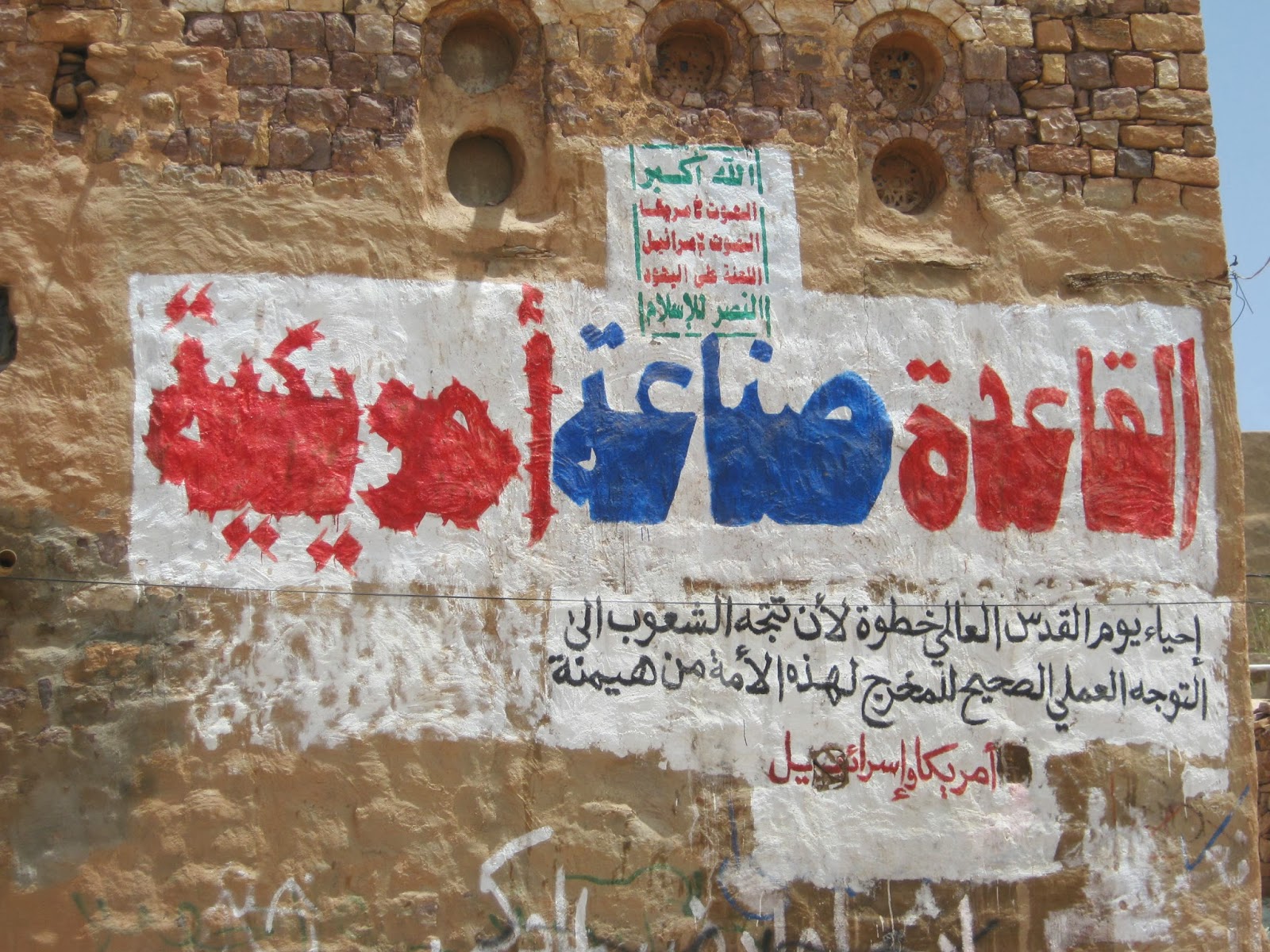
There is a fairly amusing military group called the Houthis who control the north of Yemen.  Their slogan is "God is great, death to America, death to Israel, damn the Jews, Islam will prevail", and they like to plaster this all over the place, on mosques and NGO signs and so on.  They have some beef with Al Qaeda as both think that they are the coolest terrorist group in Yemen.  I came across the below in Kawkaban, a beautiful walled city near Sana'a; the big red and blue bit reads "Al Qaeda - made in America".

Houthi graffiti

I'm stationed near the Turkey / Syria border now, luckily on the Turkish side.  This is a disappointingly sensible country so is likely to provide less fuel for this blog, but we'll see how we go.